
Ocean Without Turtles
Program Length: 45 minutes
Recommended for Elementary & Middle School Students
Program Cost: $120
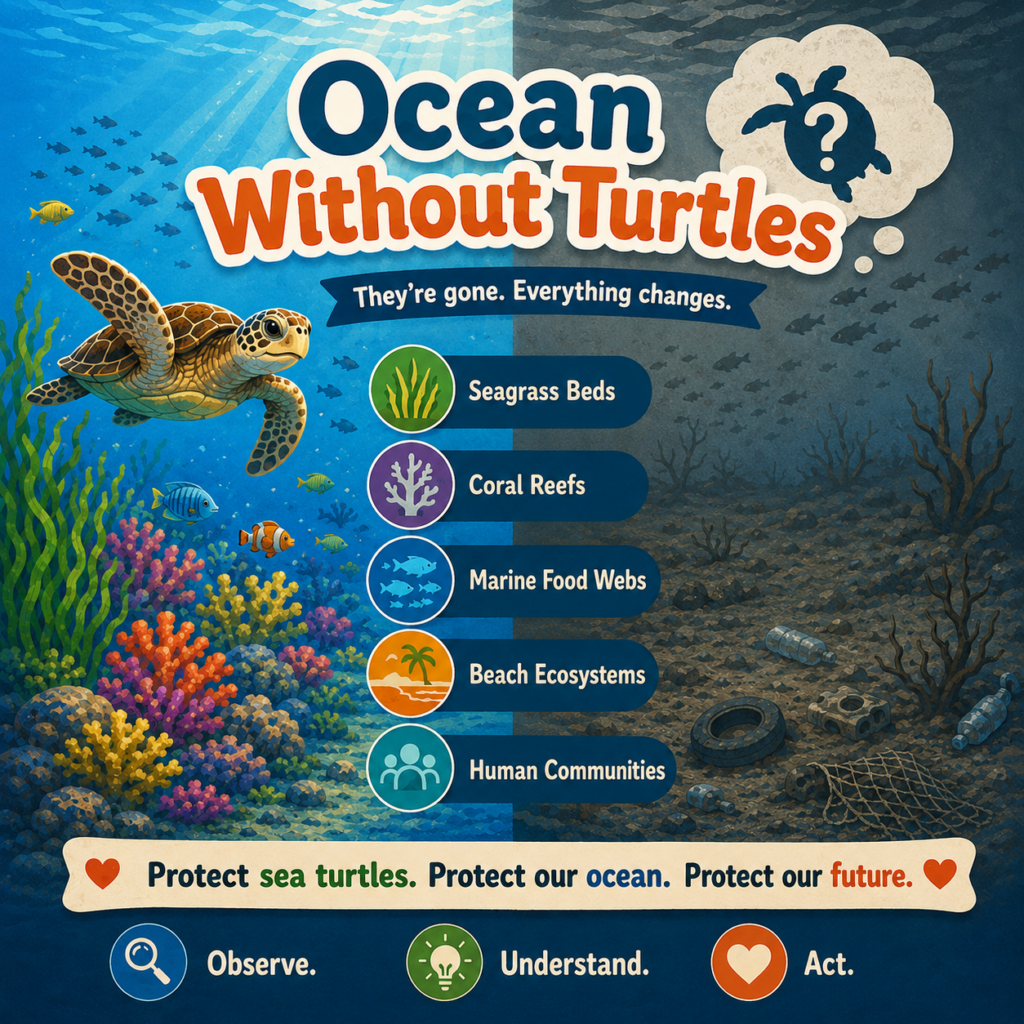
What would happen if sea turtles disappeared forever? In this thought-provoking virtual program, students become marine scientists as they investigate the important role sea turtles play in keeping ocean ecosystems healthy and balanced. Through interactive discussion and cause-and-effect exploration, students will discover how the loss of sea turtles could impact seagrass beds, coral reefs, marine food webs, beach ecosystems, and even human communities.
Students will examine real-world conservation challenges while learning why sea turtles are considered a keystone species and how protecting them helps support biodiversity across the ocean. This engaging lesson encourages critical thinking, ecosystem connections, and environmental stewardship.
Learning Objectives
At the completion of the program, students should be able to:
- Explain the ecological role sea turtles play in marine ecosystems
- Describe at least three environmental impacts that could occur if sea turtles went extinct
- Identify cause-and-effect relationships within ocean food webs
- Recognize sea turtles as a keystone species and explain why their protection matters
- Connect human actions to conservation outcomes
Texas Essential Knowledge and Skills
Grade 3 Science TEKS
- 3.1(A) – Ask questions and define problems based on observations or information from text, phenomena, models, or investigations
- 3.5(B) – Identify and describe past environments based on fossil evidence, including common Texas fossils
- 3.12(A) – Identify how plants and animals depend on each other within a habitat
- 3.12(B) – Describe and illustrate the flow of energy within food chains and food webs
Grade 4 Science TEKS
- 4.1(A) – Ask questions and define problems based on observations or information from text, phenomena, models, or investigations
- 4.12(A) – Investigate and explain how most producers can make their own food using sunlight, water, and carbon dioxide through the cycling of matter
- 4.12(B) – Describe the cycling of matter and flow of energy through food webs, including the roles of the Sun, producers, consumers, and decomposers
Grade 5 Science TEKS
- 5.1(A) – Ask questions and define problems based on observations or information from text, phenomena, models, or investigations
- 5.5(A) – Examine and explain how factors or conditions impact an ecosystem
- 5.12(A) – Observe and describe how a variety of organisms survive by interacting with biotic and abiotic factors in a healthy ecosystem
- 5.12(B) – Predict how changes in the ecosystem affect the cycling of matter and flow of energy in a food web
Grade 6 Science TEKS
- 6.1(A) – Ask questions and define problems based on observations or information from text, phenomena, models, or investigations
- 6.12(A) – Compare and contrast biotic and abiotic factors in an ecosystem
- 6.12(B) – Analyze the flow of matter and energy through trophic levels using food chains and food webs
- 6.13(A) – Describe how biodiversity contributes to the sustainability of an ecosystem
- 6.13(B) – Analyze the impact of human dependence on ocean systems and how human activities influence the environment and biodiversity
Vocabulary: Extinction, Ecosystem, Keystone Species, Food Web, Seagrass, Coral Reef, Biodiversity, Trophic Cascade.