
Living Fossils: Sea Turtles Through Time
Program Length: 60 minutes
Program Cost: $120
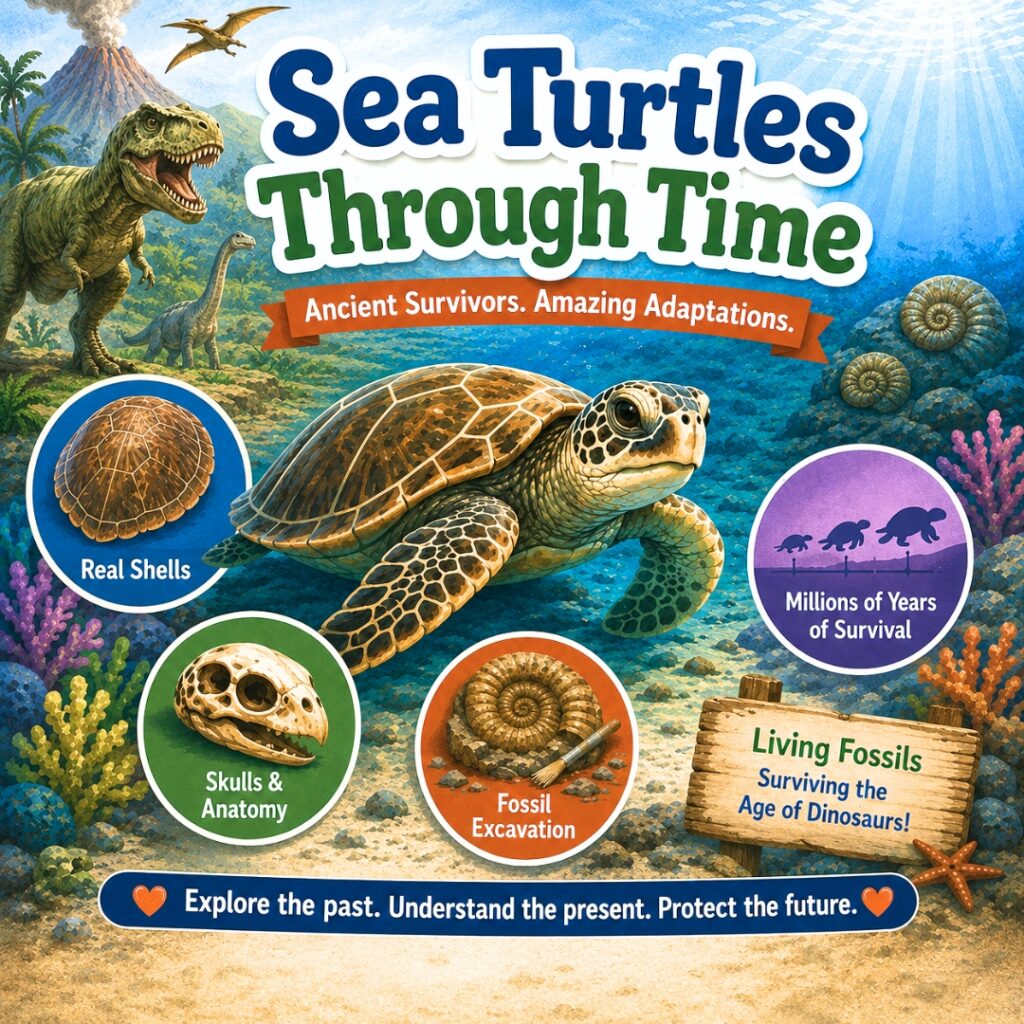
Travel back more than 100 million years to discover a time when dinosaurs ruled the land and ancient sea turtles swam the oceans. Students will investigate what fossils reveal about the past while exploring the incredible adaptations that have helped sea turtles survive since the age of dinosaurs. Participants will discover why sea turtles are often called “living fossils” and learn how Sea Turtle Inc. is working to ensure these ancient survivors continue to thrive for generations to come.
Learning Objectives
At the completion of the program, students should be able to:
- Define fossils, paleontology, excavation, adaptation, and extinction.
- Identify the characteristics of reptiles and compare sea turtles to dinosaurs.
- Explore how fossils provide evidence of organisms that lived millions of years ago.
- Examine the unique adaptations that have helped sea turtles survive for more than 100 million years.
- Compare ancient sea turtles with modern sea turtles using real shells, skulls, and anatomy demonstrations.
- Connect Earth’s prehistoric past to modern conservation and understand how Sea Turtle Inc. protects these ancient marine reptiles today.
Vocabulary: Fossil, Paleontologist, Excavation, Adaptation, Reptile, Extinct, Living Fossil, Hatchling, Conservation, Ocean
Science Texas Essential Knowledge and Skills (TEKS)
Kindergarten
- K.13A – Observe and identify the basic needs of living organisms and compare how living things meet those needs.
- K.13B – Identify different environments and how organisms depend on them.
Grade 1
- 1.13A – Classify living and nonliving things based upon whether they have basic needs and produce offspring.
- 1.13B – Analyze and record examples of interdependence found in various situations.
Grade 2
- 2.12A – Identify the basic needs of plants and animals.
- 2.12B – Identify factors in the environment that affect growth and behavior of living organisms.
Grade 3
- 3.13A – Explore how structures and functions of plants and animals allow them to survive in their environment.
- 3.13B – Investigate and compare inherited traits and learned behaviors.
Grade 4
- 4.13A – Explore and explain how structures and functions enable organisms to survive in their environment.
- 4.13B – Differentiate between inherited traits and learned behaviors.
Grade 5
- 5.13A – Compare structures and functions of different species that help them survive.
- 5.13B – Describe how environmental changes can affect organisms.
Grade 6
- 6.12A – Compare characteristics of organisms that enhance their survival and reproduction.
- 6.12B – Identify evidence of change in organisms over time using fossils and other evidence.
Grade 7
- 7.11A – Examine how internal and external structures support survival, growth, behavior, and reproduction.
- 7.11B – Explain variation within a population that enhances survival.
- 7.11C – Describe how biodiversity contributes to the sustainability of ecosystems.
Grade 8
- 8.13A – Describe how adaptations contribute to the survival of organisms.
- 8.13B – Recognize that fossil evidence provides information about organisms and environments of the past.
High School
Biology
- B.9A – Compare the structures and functions of different types of biomolecules, cells, and organisms.
- B.10A – Describe the interactions that occur among systems that perform functions required for survival.
- B.10B – Analyze how organisms maintain homeostasis through structural and behavioral adaptations.
- B.11B – Explain the significance of adaptations, natural selection, and biodiversity in populations.
Environmental Systems
- 4B – Evaluate the interdependence of organisms and the importance of biodiversity and conservation.